A garage door opener usually quits at the worst possible time – when you’re leaving for work, pulling in after dark, or trying to secure the house before bad weather rolls through. If you’re searching for how to fix garage opener problems, the first step is knowing whether you’re dealing with a simple reset or a repair that should stay in professional hands.
Most opener issues come down to a handful of causes: lost power, bad remote batteries, misaligned safety sensors, travel setting problems, or worn internal parts. Some of those are safe for a homeowner to check. Others can put the door out of balance or create a serious safety risk if the system has a spring, track, or motor problem behind it.
How to fix garage opener issues safely
Start with the safest, simplest checks first. That saves time and helps you avoid chasing the wrong problem.
Look at the opener unit itself. If there are no lights on the motor head, you may have a power issue rather than an opener failure. Check that the unit is plugged in securely and test the outlet with another device. If the outlet is dead, the fix may be a tripped GFCI outlet or breaker.
If the opener has power but does nothing when you press the remote, try the wall button. This quick test tells you a lot. If the wall button works but the remote does not, the problem is likely in the remote battery, programming, or signal. If neither control works, the issue is more likely in the opener, wiring, safety sensors, or door system.
Next, check the emergency release. Sometimes the red release cord gets pulled accidentally, disconnecting the trolley from the opener. In that case, the motor may run, but the door will not move. Re-engaging the trolley can solve the issue if the rest of the system is in good condition.
Common garage opener problems and what they mean
When the opener hums but the door does not lift, that usually points to a mechanical problem rather than a button or sensor issue. The door may be locked manually, the trolley may be disconnected, or the door may be too heavy for the opener because of a broken spring. If a spring is broken, stop there. A garage opener is not designed to lift a door with a failed spring, and forcing it can burn out the motor or bend components.
If the door starts down and then reverses, the safety sensors are one of the first things to inspect. These are the photo eyes mounted near the bottom of the tracks. If they are dirty, bumped out of alignment, or blocked by debris, the opener treats that as an obstruction and reverses the door.
If the door closes fully and then pops back open, the travel or force settings may be off. Openers are adjusted to stop at the right point with the right amount of force. If those settings drift, the opener may think the door hit something when it really just reached the floor.
If the opener works inconsistently in cold weather, Ohio homeowners see this more often than they should. Low temperatures can stiffen grease, affect sensor performance, and expose weak parts that were already on the way out. A door that moves slowly, jerks, or stalls in winter may have an opener issue, but it may also be telling you the rollers, springs, or tracks need attention.
Check the remote, keypad, and wall control
A lot of opener calls start with a control problem, not a failed motor. Replace the battery in the remote first. It is basic, but it solves more problems than most people expect.
If a remote still does not work after a new battery, reprogram it to the opener. The exact steps depend on brand and model, but most units use a learn button on the motor head. Press the learn button, then press the remote button you want to pair. If the opener light blinks, the remote has usually been accepted.
For a wireless keypad, battery condition and programming are the two main checks. If the keypad lights up but does not open the door, the code may need to be reset. If it does nothing at all, start with the battery and inspect for moisture damage.
If the wall control is unresponsive, inspect the wires if they are visible and accessible. Low-voltage wall control wires can come loose or become damaged. If you see frayed wire, staples driven too tightly, or a disconnected terminal, that may be the cause. If not, the issue may be inside the opener logic board.
Inspect the safety sensors the right way
Safety sensors stop the door from closing on a person, pet, or object. They are small, but they matter.
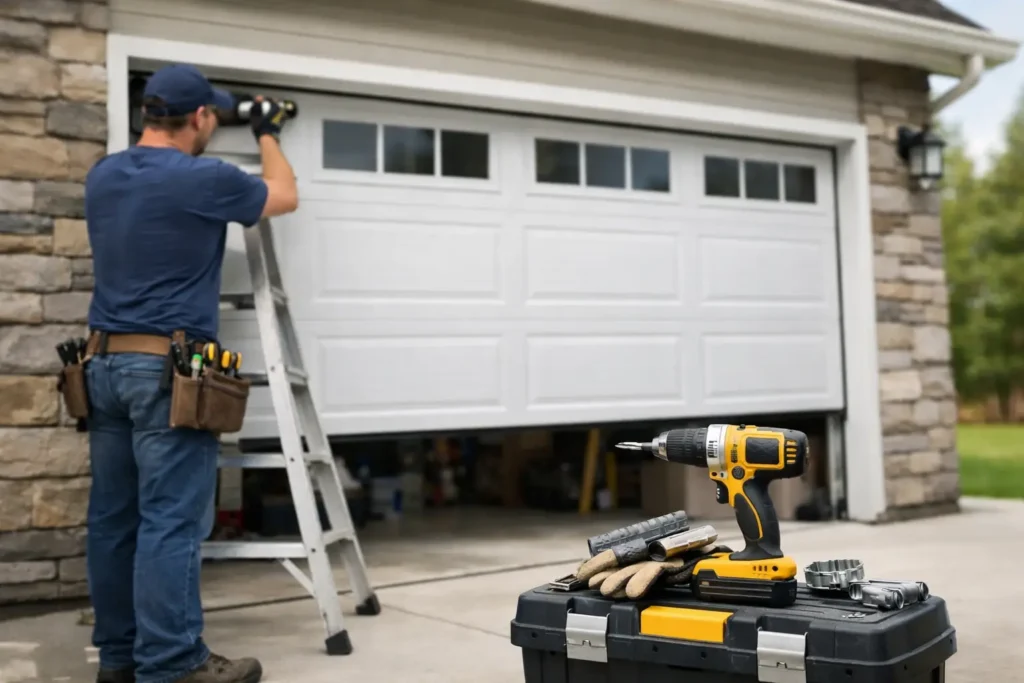
Check both sensor lenses for dirt, cobwebs, or moisture. Clean them gently with a soft cloth. Then look at the indicator lights. Most sensors show a steady light when aligned correctly. If one light is off or blinking, alignment is the likely problem.
Loosen the mounting bracket slightly, adjust the sensor until the light turns steady, and retighten it. This sounds simple because it often is, but it depends on the bracket not being bent and the wiring not being damaged. If the sensors will not hold alignment, the bracket or track may be the real issue.
Do not bypass sensors. That turns a safety system into a hazard.
When opener settings are the problem
Modern garage door openers have limit and force settings that tell the motor how far the door should travel and how much resistance is acceptable. If those settings are wrong, the door may not close all the way, may reverse unexpectedly, or may slam harder than it should.
You can adjust these settings on many units, but this is where homeowners should slow down. A small adjustment can help. Too much adjustment can hide a bigger problem. For example, increasing force may get the door moving again, but if the real issue is a binding track or failing spring, the opener is being asked to compensate for a dangerous condition.
That is the trade-off with DIY troubleshooting. You may restore operation, but you may also mask the root cause long enough for more damage to happen.
Signs the problem is not the opener at all
People often say the opener is broken when the real failure is somewhere else in the system. If the door is crooked, jerky, unusually loud, or too heavy to lift manually with the opener disconnected, the door hardware needs attention.
Watch for a visible gap in a torsion spring, hanging cables, bent track, damaged rollers, or a door section that looks shifted. In those situations, the opener is usually reacting to the problem, not causing it.
This matters because replacing an opener will not fix an unbalanced door. In fact, a new opener attached to a bad door can fail early. A complete diagnosis should always include the door, springs, rollers, tracks, and opener working together.
When to stop troubleshooting and call a pro
Some garage opener problems are appropriate for homeowner checks. Others need trained repair service right away.
If you suspect a broken spring, damaged cable, burnt motor, stripped gear, logic board failure, or door imbalance, stop using the system. These repairs involve heavy moving parts, stored tension, or electrical components that should be handled by certified technicians.
The same applies if the opener trips the breaker repeatedly, gives off a burning smell, or makes grinding noises. Those are not reset-and-go issues. They usually point to internal wear or overload conditions that need proper testing.
For homeowners in Wapakoneta and nearby communities, fast service matters because a stuck garage door is not just inconvenient. It affects security, access, and safety. That is why experienced local companies focus on same-day response, proper diagnosis, and repairs backed by warranty rather than guesswork.
The smartest way to prevent repeat opener problems
If you want fewer opener failures, think beyond the motor. Keep the sensor area clean, replace remote batteries before they go completely dead, and pay attention when the door starts sounding different. A garage door system usually gives warning signs before it stops working altogether.
It also helps to schedule professional maintenance if the door is older or gets heavy daily use. A trained technician can spot balance issues, worn rollers, loose hardware, and opener strain before they turn into a breakdown. That kind of service is especially valuable after hard seasonal swings, because cold weather and humidity can expose weak points fast.
If your opener is acting up, start with the simple checks. If the door is heavy, uneven, noisy, or unreliable, treat it like a full system problem until proven otherwise. The safest repair is the one that fixes the cause, not just the symptom.